

Call Us:
(03) 7037 0931
M-F 9am to 5pm

Choosing the best chess board is more personal than you might think. It's not just about having a flat surface with 64 squares – it's about finding a board that matches your playing style, fits your space, and honestly just makes you want to sit down and play. Whether you're setting up in your lounge room, taking your game to the park, or building a collection that'd make any chess enthusiast jealous, the right board can transform your entire experience. Let's walk through everything you need to know to find your perfect match.
The foundation of any decent chess board comes down to three key elements: proper square sizing, quality materials, and thoughtful construction. You'll want squares that are large enough to comfortably fit your pieces without crowding – the golden rule suggests each square should be roughly 1.25 to 1.3 times the diameter of your king's base. Too small and your pieces feel cramped; too large and the board loses its visual balance.
Contrast between light and dark squares matters more than most people realise. Your eyes need to track pieces across the board for hours sometimes, and poor contrast causes unnecessary fatigue. The best boards use colour combinations that are distinct but not harsh – think warm maple against rich walnut rather than stark black and white.
Key features to prioritise:
Build quality separates boards you'll use for decades from those you'll replace in a year. Premium boards feature solid construction, whether that's through quality wood joinery, precision-cut materials, or reinforced backing that prevents warping over time.
Wood remains the gold standard when you're shopping for the best chess board. There's something timeless about the grain patterns, the warm feel under your fingers, and the solid 'clack' when you place a piece. Understanding the different types of wood used in chess boards reveals why certain woods have become favourites among serious players.
| Light Square Wood | Dark Square Wood | Characteristics | Best For |
|---|---|---|---|
| Maple | Walnut | Classic contrast, durable | Tournament and home play |
| Birch | Mahogany | Rich tones, elegant | Display and serious play |
| Sycamore | Rosewood | Luxury appearance | Collectors and gifts |
| Ash | Padauk | Bold contrast, modern | Contemporary settings |
Maple and walnut combinations dominate the luxury chess boards market for good reason. Maple's light, consistent grain pairs beautifully with walnut's chocolate tones, creating that instantly recognizable chess aesthetic. These woods are hard enough to resist denting from piece placement but not so hard they're brittle.
Mahogany brings warmth and richness to any board. Its reddish-brown hue deepens over time, developing character that tells the story of countless games played. Paired with lighter woods like birch or maple, mahogany creates an elegant contrast that looks stunning whether you're mid-game or displaying the board in your study.
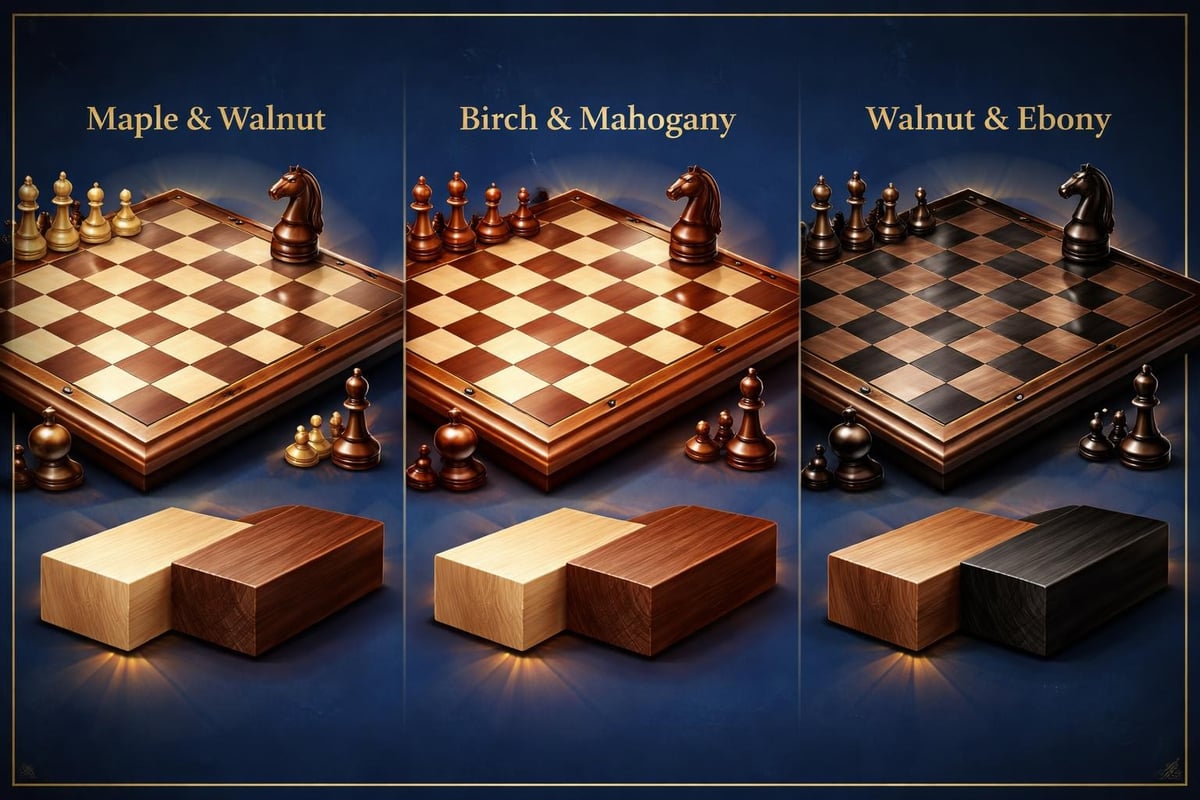
Exotic woods like rosewood, ebony, and padauk elevate boards into true collector territory. These materials often come from sustainable sources and carry premium price tags, but they deliver unmatched visual drama. A rosewood and ebony board isn't just functional – it's a statement piece that commands attention.
Solid wood boards are exactly what they sound like – pieces cut from actual timber, joined together to create the playing surface. They're heavier, more substantial, and can be refinished if they ever get scratched or worn. The best chess board candidates in solid wood will last generations with proper care.
Veneer boards use thin layers of quality wood bonded to a stable base material. Don't let that put you off – high-quality veneer construction can produce absolutely stunning boards at more accessible prices. The key is ensuring the veneer is thick enough (at least 2-3mm) and properly adhered to prevent lifting or bubbling.
Not everyone wants a traditional wooden board, and that's completely fine. Modern materials offer distinct advantages depending on how and where you play. Different chess board materials each bring their own personality to the game.
Glass boards scream modern sophistication. They're perfect for contemporary spaces where traditional wood might look out of place. The smooth surface feels amazing under your fingers, and quality glass chess boards feature frosted squares that prevent glare while maintaining that sleek aesthetic.
Cleaning is dead simple – a quick wipe and you're done. However, glass is heavy and obviously fragile. These boards shine brightest as display pieces or for leisurely home games rather than rough-and-tumble tournament play.
Want something that'll outlast you, your kids, and probably their kids? Marble chess boards deliver permanence and gravitas. Each board is genuinely unique thanks to natural stone variations, turning every set into a one-of-a-kind piece.
The weight is substantial – these aren't boards you'll be moving around regularly. But that heft brings stability. Pieces sit securely without sliding, and the cool stone surface adds a tactile dimension to your game. Just be mindful that dropped pieces can chip the squares, so these work best for careful, deliberate play.
Tournament players and coaches swear by roll-up boards for portability. Modern vinyl and silicone versions lie completely flat, resist curling at the edges, and handle years of rolling and unrolling. They're the best chess board option when you need something you can chuck in a bag and go.
Advantages of portable boards:
Quality matters here too. Cheap vinyl boards arrive with permanent creases and curl at the corners. Better versions use heavier materials with reinforced edges that stay flat and last for years of regular use.
If you're playing in official competitions, your board needs to meet specific requirements. Tournament chess boards adhere to FIDE standards that ensure consistency across competitive play worldwide.
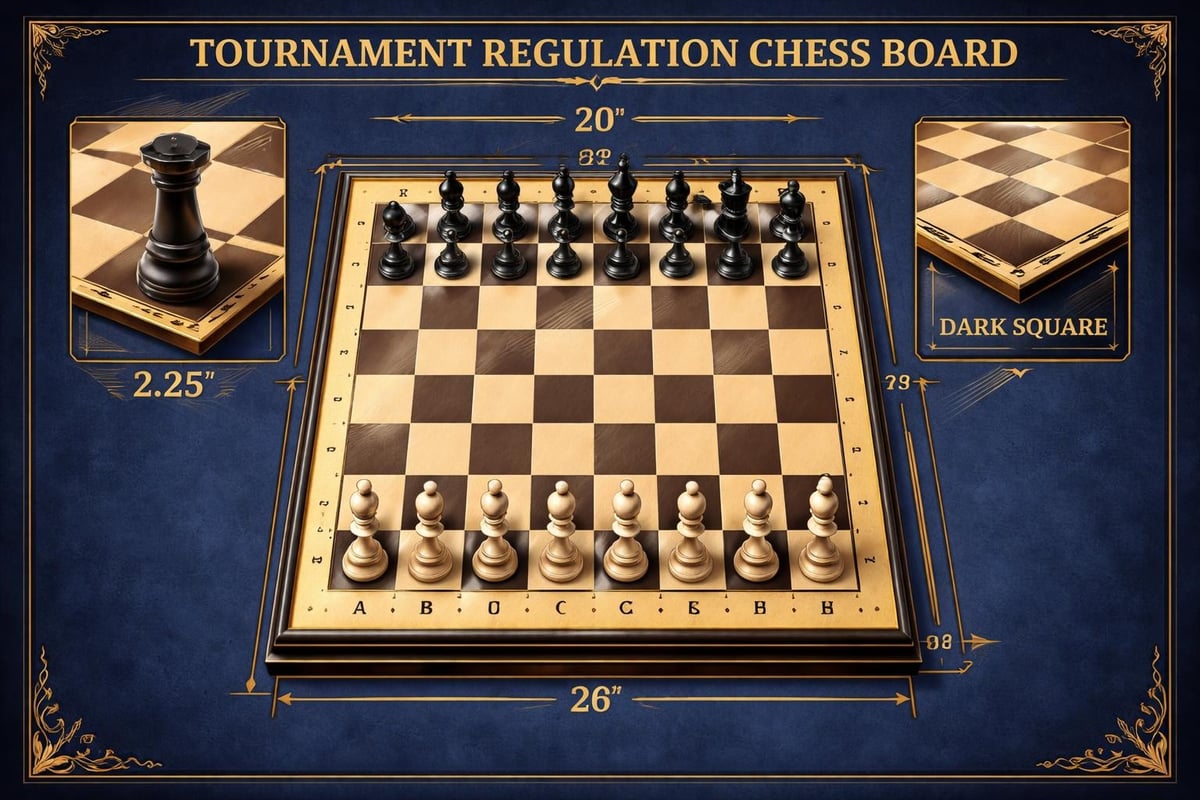
Square size must fall between 5 to 6.5 centimeters (roughly 2 to 2.5 inches). This sizing works with standard Staunton pieces and provides enough space for quick, confident piece placement during timed games. The board should also have algebraic notation printed or inlaid around the edges for score keeping and game analysis.
Colour matters in tournament settings. The light squares should be off-white or cream rather than pure white, which can cause eye strain under fluorescent lighting. Dark squares typically run from brown to dark green, avoiding pure black for the same reason.
Your playing situation might call for something beyond a standard board. Magnetic chess boards keep pieces secure during travel or outdoor play, making them brilliant for caravanning, boating, or playing in the park. The magnets are strong enough to hold pieces through bumps and wind but not so strong you'll struggle to make moves.
Folding boards solve the storage puzzle elegantly. Quality foldable chess boards use piano hinges and precise construction so the center fold doesn't disrupt play. Many include storage compartments for pieces, creating a complete package that fits in a drawer or on a shelf.
Size matters when space is limited. Compact boards with 1.5-inch squares work perfectly for cramped airline tray tables or hotel rooms. You'll sacrifice some comfort in piece handling, but the portability makes up for it when you're on the move.
The best chess board for you balances durability with visual appeal in a way that matches your priorities. Someone displaying their board between games cares more about aesthetics. Someone teaching kids twice a week needs something that'll survive punishment.
Premium wood chess boards typically use lacquer or polyurethane finishes that protect the wood while highlighting its natural beauty. Multiple thin coats work better than one thick layer, creating a smooth surface that resists scratches and moisture without looking plasticky.
| Material | Durability | Maintenance | Visual Appeal | Price Range |
|---|---|---|---|---|
| Solid hardwood | Excellent | Moderate | Classic | High |
| Wood veneer | Good | Low | Traditional | Medium |
| Marble/Stone | Excellent | Very low | Luxurious | High |
| Glass | Fair | Very low | Modern | Medium-High |
| Vinyl/Silicone | Good | Very low | Functional | Low |
Inlay work separates ordinary boards from extraordinary ones. The best chess board examples in high-end collections feature individual wood squares precisely cut and fitted together, creating seamless transitions between light and dark. This construction method allows for repairs – damaged squares can be replaced individually without junking the entire board.
Metal accents add character to wooden boards. Bronze or brass trim around the edges provides both protection and visual interest. Some luxury boards incorporate metal into the squares themselves, creating stunning modern designs that push beyond traditional aesthetics.
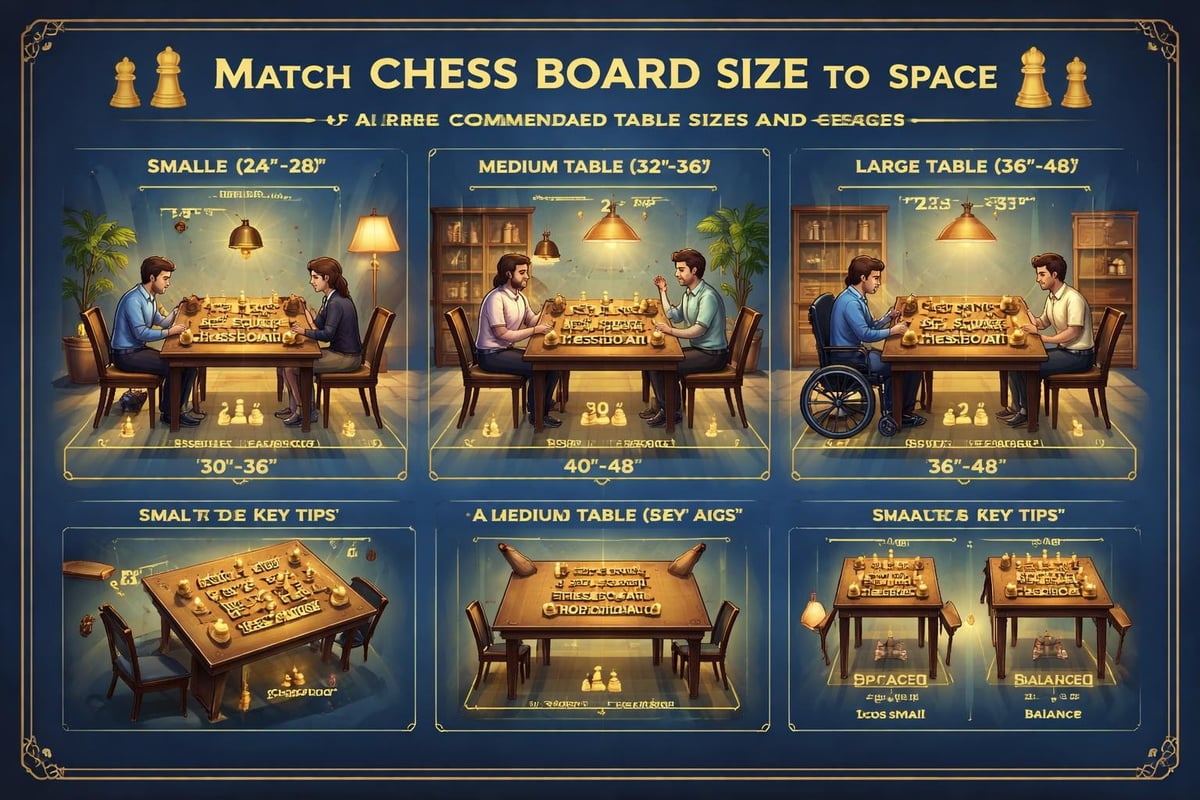
Your available space should guide your board selection as much as your budget. A massive 23-inch board looks incredible but feels awkward crammed onto a small coffee table. Similarly, a tiny travel board gets lost on a large chess table.
Standard board sizes and their ideal uses:
Allow at least 6 inches of clearance around all sides of your board. You need room to comfortably reach all squares, set down captured pieces, and position your clock if you're using one. Players also appreciate elbow room – cramped quarters lead to knocked pieces and frustrated games.
Table height matters too. Your board should sit at a comfortable height where you can see the entire position without hunching. Standard dining table height (75cm) works well for most people, but coffee table boards might require floor cushions or lower chairs for comfortable extended play.
The relationship between board and pieces makes or breaks the visual harmony of your set. Too-large pieces crowd the squares and limit movement. Too-small pieces look lost and make the board feel empty. The standard ratio suggests your king should be 75-80% of the square size.
If you've already got pieces you love, measure your king's base diameter and multiply by 1.3 to find your ideal square size. Working backwards from a board you fancy? Divide the square size by 1.3 to determine the maximum king base that'll look proportional.
Colour coordination extends beyond just matching woods. Consider how your piece colour interacts with both square colours. Dark ebony pieces look stunning on boards with lighter overall tones, while boxwood pieces pop against darker boards. Staunton chess pieces in traditional ebony and boxwood remain popular precisely because they work beautifully with standard board colour schemes.
The best chess board for your situation doesn't mean the most expensive one. It means finding the sweet spot where quality, features, and price align with your actual needs. A $2000 rosewood masterpiece isn't worth it if you're learning the game and might not stick with it. Equally, a $30 vinyl board frustrates serious players who'll use it daily.
Entry Level ($50-150): Solid construction in common woods or quality veneers. These boards play perfectly well but skip the premium materials and decorative inlays. Great for learning, teaching, or casual play.
Mid-Range ($150-500): Better wood selection, superior construction techniques, and thoughtful design details. Wood chess boards in this range often feature quality hardware, smooth finishes, and woods that'll age beautifully.
Premium ($500-1500): Exotic woods, expert craftsmanship, and attention to every detail. These boards become family heirlooms that improve with age. The playing experience is noticeably superior.
Collector Grade ($1500+): Art pieces that happen to be functional boards. Think rare woods, master craftspeople, limited editions, and designs that push boundaries. You're paying for uniqueness and exceptional materials.
Value isn't just about upfront cost. A quality board that lasts 20 years costs less per game than a cheap board replaced every two years. Factor in how often you'll play, how much you care about aesthetics, and whether this board might become an heirloom when calculating true value.
Protecting your investment means understanding how different materials age and what they need to stay beautiful. Wooden boards fear moisture and extreme temperature changes more than anything. Never store them in damp basements or hot attics where wood can warp or crack.
Glass and marble boards need less coddling but aren't indestructible. Use proper cleaning products for the specific material – glass cleaners work great on glass but can damage wood finishes. Stone boards benefit from occasional sealing to prevent staining.
Vinyl boards just need basic cleaning and proper rolling. Always roll with the squares facing outward (creating a loose coil) rather than inward (creating tight creases). Store them in tubes or hanging to prevent permanent bending.
Technology is changing what a chess board can do. Electronic chess boards connect to computers and apps, automatically recording your games and enabling online play with a physical board. Some models include built-in coaching that suggests moves or highlights tactical opportunities.
These boards let you play against chess engines at your actual board rather than staring at a screen. You make moves physically, and the board lights up to show the computer's response. It's the best of both worlds – traditional tactile play with modern analysis tools.
Smart boards vary wildly in quality and features. Basic models simply detect piece movement and transmit to a connected device. Advanced versions include full game databases, multiple difficulty levels, and coaching modes that adapt to your skill level. The best chess board in this category depends entirely on which features you'll actually use versus ones that sound cool but gather dust.
Bringing everything together means honestly assessing your priorities. Are you primarily playing, collecting, or displaying? How much space do you have? What's your budget? Who else will use this board?
Consider the journey you're on with chess. Beginners might start with a solid mid-range board that'll serve them well as they improve. Serious players often own multiple boards – a quality wooden set for home study, a roll-up for tournaments, maybe a luxury board for special occasions.
The best chess board encourages you to play more often. If you love how it looks and feels, you'll find yourself setting up positions just for fun, replaying historic games, or inviting friends over for a match. That emotional connection matters as much as any technical specification.
Think about where you'll play most often. Outdoor enthusiasts need weather-resistant materials. Apartment dwellers benefit from boards with storage. People who play in multiple locations want something portable. Match the board's strengths to your lifestyle.
Finding the best chess board transforms how you experience the game, whether you're studying openings at home or displaying a treasured set between matches. Quality craftsmanship, appropriate materials, and thoughtful design all contribute to boards you'll cherish for decades. At Sterling Chess, our team helps players and collectors discover boards that match their style, space, and budget – from tournament-ready maple and walnut to stunning marble and exotic wood showpieces. We're passionate about connecting you with chess boards that elevate every game and look magnificent whether you're playing or simply admiring the craftsmanship.
Leave a comment