

Call Us:
(03) 7037 0931
M-F 9am to 5pm

If you're serious about chess - whether you're stepping into tournament play, setting up a club, or simply want a set that meets the highest standards - you've probably come across the term "fide chess set". But what exactly does that mean? It's not just marketing jargon. A fide chess set meets specific requirements set by the World Chess Federation (FIDE), the international governing body for competitive chess. These standards ensure consistency, fairness, and clarity in tournament play around the globe. Let's dive into what makes a chess set FIDE-compliant, why it matters, and how to choose the right one for your needs.
The term "fide chess set" refers to equipment that meets the official standards outlined in FIDE's regulations for chess equipment. These aren't arbitrary rules - they're carefully designed to create a level playing field for competitors worldwide.
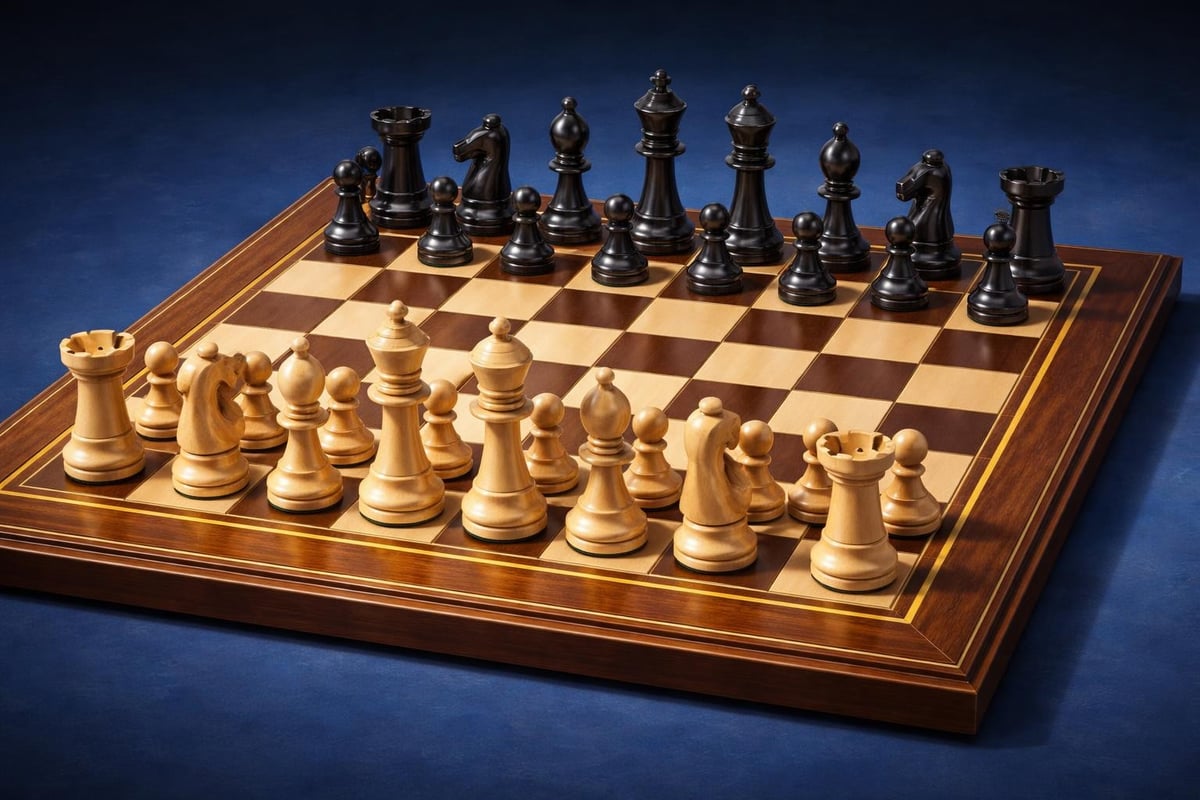
At the heart of every fide chess set is the Staunton design. This iconic style has been the standard since the mid-1800s and was officially adopted by FIDE for tournament play. The Staunton chess set features instantly recognizable pieces: a king with a cross finial, a bishop with a mitre-shaped top, and a knight that's become one of the most challenging and beautiful pieces to carve.
Why Staunton? The design strikes the perfect balance between elegance and functionality. Each piece is instantly distinguishable from the others, even in your peripheral vision during fast-paced games. That clarity matters when you're in the middle of a timed match.
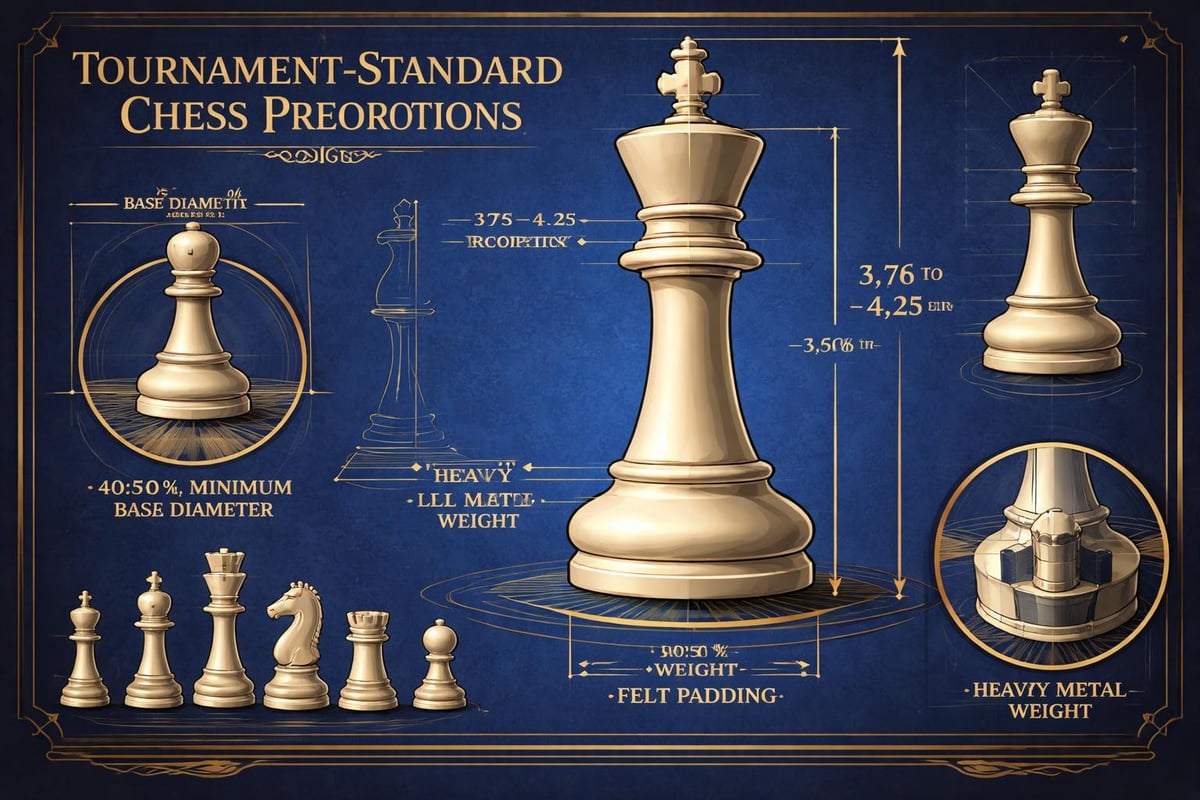
FIDE doesn't just care about style - they're specific about size too. Here's what you need to know:
| Piece Type | Height Requirement | King Base Diameter |
|---|---|---|
| King | 85-105 mm | 40-50% of height |
| Other Pieces | Proportionate to king | N/A |
| Weight | Stable, bottom-weighted | Solid base required |
The king typically stands between 85 and 105 millimeters tall, with a base diameter that's 40-50% of its height. This ratio ensures stability during play. The other pieces should be proportioned appropriately to the king, creating a harmonious set that's easy to handle and won't topple over at the slightest touch.
While FIDE allows some flexibility in materials, there are practical considerations. Most tournament-quality sets use:
The pieces must be well-balanced and bottom-weighted. You'll often find this achieved through adding metal weights in the base, then covering them with felt or leather. This prevents sliding and makes the pieces feel substantial in your hand.
A fide chess set isn't complete without a proper board. FIDE has clear requirements here too, and they're all about playability.
The squares should measure between 50 and 60 millimeters on each side. This pairs perfectly with the piece sizing - the king's base should fit comfortably within a square, taking up roughly 75-80% of its width. Too tight, and the board feels cramped. Too loose, and you lose that satisfying precision when placing pieces.
Color contrast is another key element. The board must have clearly distinguishable light and dark squares. While traditional sets use light and dark wood tones, you'll also see green and white combinations in many tournament settings. The bottom-right square from each player's perspective must be light-colored - that's your quick reference for correct board orientation.
Beyond the basics, quality tournament boards include:
At Sterling Chess, we understand that these details transform a simple board into a professional playing surface that enhances rather than distracts from your game.
You might be thinking, "I'm not playing in FIDE tournaments, so why should I care about these standards?" Fair question. Here's why a fide chess set makes sense even if you're never entering competitive play.
Muscle memory and consistency - if you practice on regulation equipment, you're training with the same piece proportions and board feel you'd encounter at any chess club or casual tournament. Switch between wildly different sets, and you're constantly adjusting.
Resale value - quality sets that meet FIDE standards hold their value remarkably well. They're always in demand from players, clubs, and collectors.
Universal recognition - when someone sees a proper Staunton set, they immediately know what they're looking at. It's the visual language of serious chess.
Plus, there's something deeply satisfying about playing on equipment that meets the highest standards. It's like the difference between practicing piano on a quality instrument versus a cheap keyboard. The experience just feels right.
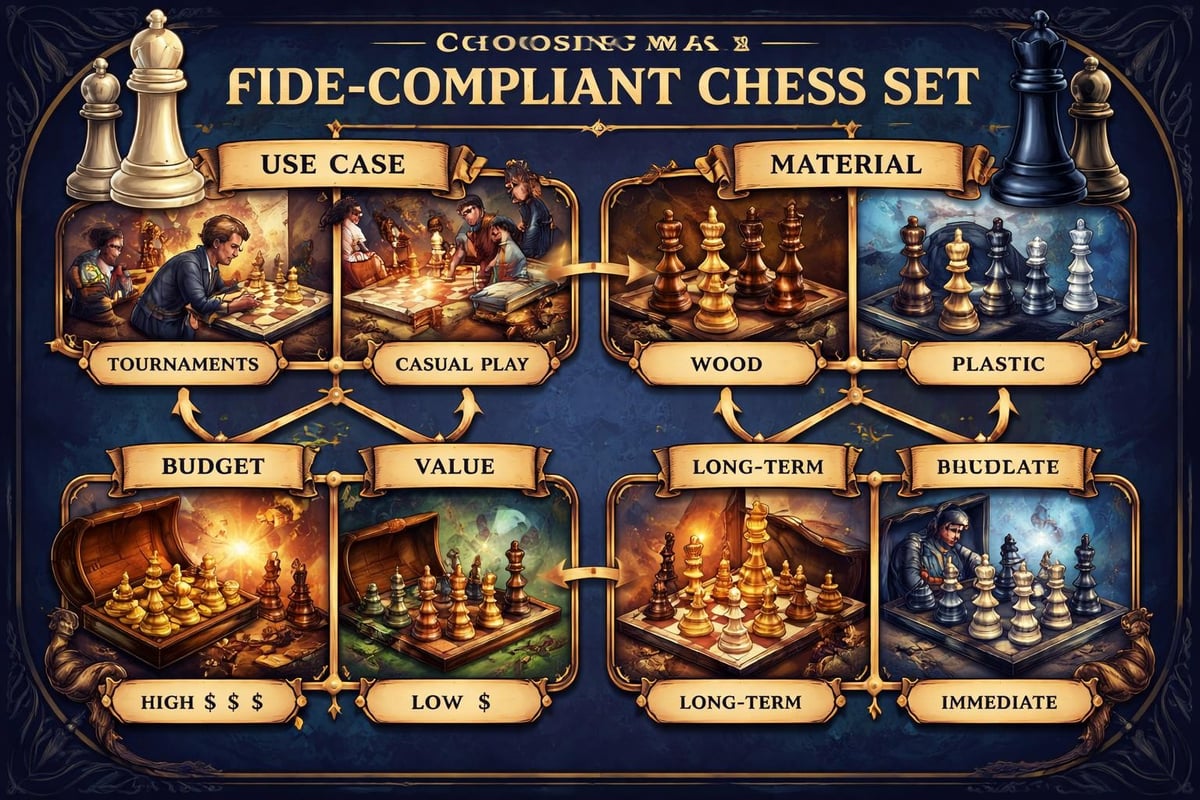
Ready to invest in a fide chess set? Here's how to make the right choice for your situation and budget.
| Use Case | Recommended Features | Budget Range |
|---|---|---|
| Home practice | Wooden pieces, folding board | Medium |
| Club play | Weighted plastic, roll-up board | Low-Medium |
| Tournament use | Premium wood, rigid board | Medium-High |
| Display/Collection | Luxury wood, presentation board | High |
Home practice sets benefit from a balance of quality and convenience. A beautiful wooden chess set that meets FIDE standards will serve you for decades and become a cherished piece of furniture.
Club players often prefer durable plastic sets with heavy weighting. They stand up to frequent handling and transport without the worry of damaging expensive wooden pieces. Many chess clubs have multiple sets that get used daily - durability matters.
Tournament players want equipment that feels premium but won't break the bank if damaged during travel. Mid-range wooden sets with quality construction offer the best value here.
For wooden sets, the species matters:
Each wood brings different characteristics in weight, grain pattern, and durability. Understanding the official FIDE Laws of Chess equipment standards can help you make informed decisions about materials and construction quality.
Let's clear up some confusion that often surrounds tournament-standard chess equipment.
Myth: All Staunton sets are FIDE-compliant Not true. While FIDE requires the Staunton design, not all Staunton sets meet the size and proportion requirements. Some decorative sets use the Staunton style but scale pieces differently or use non-standard materials.
Myth: Plastic sets can't be FIDE-compliant Completely false. Many official tournaments use high-quality plastic sets. Material doesn't determine compliance - dimensions and design do. Plastic sets meeting FIDE standards are perfectly legitimate for tournament play.
Myth: You need different sets for rapid and classical chess The same fide chess set works for all time controls. FIDE's equipment standards apply across classical, rapid, and blitz formats. You might see different chess clocks for different time controls, but the sets remain consistent.
Myth: Heavier always means better Weight matters, but there's a sweet spot. Pieces should be stable without being cumbersome. Over-weighted pieces can actually slow down your play and cause fatigue during long games.
Here's something important: individual chess sets don't receive "FIDE certification" the way you might think. Instead, FIDE publishes standards, and manufacturers produce sets that comply with these specifications. When you see a set described as "FIDE-approved" or "tournament-legal," it means the manufacturer has designed it to meet the published standards.
A complete tournament setup includes more than just pieces and a board. Here's what serious players consider:
FIDE tournaments require approved digital clocks with specific features. Modern chess clock technology has evolved significantly, offering delay and increment functions that weren't possible with mechanical clocks. While not part of the "set" itself, having a quality clock that meets tournament standards completes your setup.
Tournament players need to record their games. Standard notation pads, designed specifically for chess, make this process smooth. Having algebraic notation on your board's borders helps tremendously when writing down moves quickly.
If you're taking your set to clubs or tournaments, proper storage matters. Quality sets often come with fitted boxes or cases. For boards, roll-up vinyl options work brilliantly for transport, though wooden boards with folding hinges offer a more traditional feel at home.
Buying a fide chess set is an investment in your chess journey. Unlike cheaper decorative sets, tournament-standard equipment holds its value and functionality for decades.
Budget considerations:
The beauty of investing in quality is that you're unlikely to need another set for years, possibly decades. A well-made fide chess set doesn't become obsolete - the standards have remained remarkably consistent since FIDE formalized them.
Once you've invested in a quality fide chess set, proper care ensures it lasts. Wooden pieces benefit from occasional treatment with a wood-safe polish or wax, though many prefer the natural patina that develops over time. Keep pieces away from direct sunlight, which can fade colors and dry out wood.
Maintenance checklist:
For boards, avoid folding wooden boards repeatedly in the same position - this can weaken hinges. Roll-up boards should be stored loosely rolled rather than tightly compressed. Wipe down playing surfaces regularly to remove oils from hands.
The requirements for a fide chess set have remained relatively stable, which is actually one of their strengths. However, FIDE continues to refine standards as new materials and manufacturing techniques emerge. Recent discussions within FIDE's technical committees have explored electronic board integration and digital piece tracking, though these innovations complement rather than replace traditional sets.
If you're curious about the latest developments, FIDE's approach to setting standards for chess organizers provides insight into how the organization balances tradition with innovation.
The core elements - Staunton design, specific sizing ratios, quality construction - aren't likely to change. They represent over a century of refinement, creating equipment that works brilliantly for the game we love.
Choosing your fide chess set comes down to balancing several factors: your budget, primary use case, aesthetic preferences, and long-term goals in chess. There's no single "perfect" set - only the perfect set for you right now.
Questions to ask yourself:
Many serious players eventually own multiple sets - a beautiful wooden set for home, a durable plastic set for travel, perhaps a luxury chess set for special occasions. There's no shame in starting with a quality entry-level set and upgrading as your appreciation deepens.
Understanding what makes a set truly tournament-compliant helps you avoid purchasing equipment that won't serve you well in the long run. The criteria discussed in detailed forum discussions about FIDE tournament requirements can guide your selection process, ensuring you invest wisely.
Choosing a fide chess set that meets official tournament standards ensures you're playing on equipment designed for serious chess, whether you're competing or enjoying casual games at home. Understanding piece dimensions, board specifications, and quality construction helps you make an informed investment that'll serve you for years. If you're ready to explore FIDE-compliant sets crafted with attention to detail and traditional excellence, discover our curated collection at Sterling Chess, where every set is selected for quality, playability, and the enduring beauty that makes chess special.
Leave a comment