

Call Us:
(03) 7037 0931
M-F 9am to 5pm

Whether you're just starting your chess journey or looking to deepen your understanding of the game, a thorough explanation of chess pieces is essential. Each of the six different piece types has its own unique movement pattern, strategic role, and tactical value. Understanding how these pieces work together transforms chess from a simple board game into a rich battlefield of strategy and calculation. At Sterling Chess, we know that appreciating the craftsmanship of quality chess sets begins with understanding the pieces themselves and how they bring this timeless game to life.
Pawns might be the smallest pieces on the board, but they're the backbone of your entire strategy. These eight soldiers form your first line of defence and your potential path to promotion.
Pawns move forward one square at a time, with the special option of moving two squares on their very first move. Unlike other pieces, pawns capture differently than they move, taking opponent pieces diagonally rather than straight ahead. This unique characteristic makes pawn structure one of the most critical elements in positional play.
There are two special moves exclusive to pawns that every player needs to master:
The beauty of pawns lies in their potential. While they're valued at just one point in the standard chess piece valuation system, a well-positioned pawn can control critical squares and restrict powerful pieces like knights and bishops.

Knights are the quirky characters of chess, moving in an L-shaped pattern that baffles beginners and delights masters. This explanation of chess pieces wouldn't be complete without highlighting what makes knights so special: they're the only pieces that can jump over other pieces.
A knight moves two squares in one direction and then one square perpendicular to that, or vice versa. This creates up to eight possible moves from any position, though knights near the board's edge have fewer options. Their unique movement pattern means they can control squares that other pieces can't easily reach.
| Aspect | Details |
|---|---|
| Point Value | 3 points |
| Colour Restriction | Changes square colour with every move |
| Best Position | Centre of the board (controls 8 squares) |
| Worst Position | Corner (controls only 2 squares) |
Knights work brilliantly in closed positions where pawns block the long-range pieces like bishops and rooks. They're particularly effective at creating forks, simultaneously attacking two or more pieces. When you're selecting pieces from our premium chess sets, you'll notice the knight often features the most intricate carving, reflecting its special role in the game.
Bishops glide along diagonals for as many squares as they want, limited only by the board's edge or other pieces in their path. Each player starts with two bishops: one that moves on light squares and one on dark squares. This colour restriction never changes throughout the game.
The long-range nature of bishops makes them particularly powerful in open positions where pawn structures don't block diagonal lines. A bishop can control up to 13 squares from the centre of the board, making it a formidable attacking and defensive piece.
Having both bishops when your opponent doesn't is often considered a significant advantage:
Bishops are generally valued at three points, the same as knights, though their relative value increases as more pawns are exchanged and the position opens up. Understanding the basics of chess includes recognizing when bishops become more valuable than knights and vice versa.

Rooks are the heavy artillery of chess, moving horizontally or vertically for any number of squares. These powerful pieces are worth approximately five points each, making them significantly more valuable than bishops or knights but less powerful than the queen.
What makes rooks particularly strong is their ability to control entire ranks and files. A rook on an open file (a vertical column with no pawns) becomes a dominating force, often penetrating to the seventh or eighth rank where it can attack multiple targets.
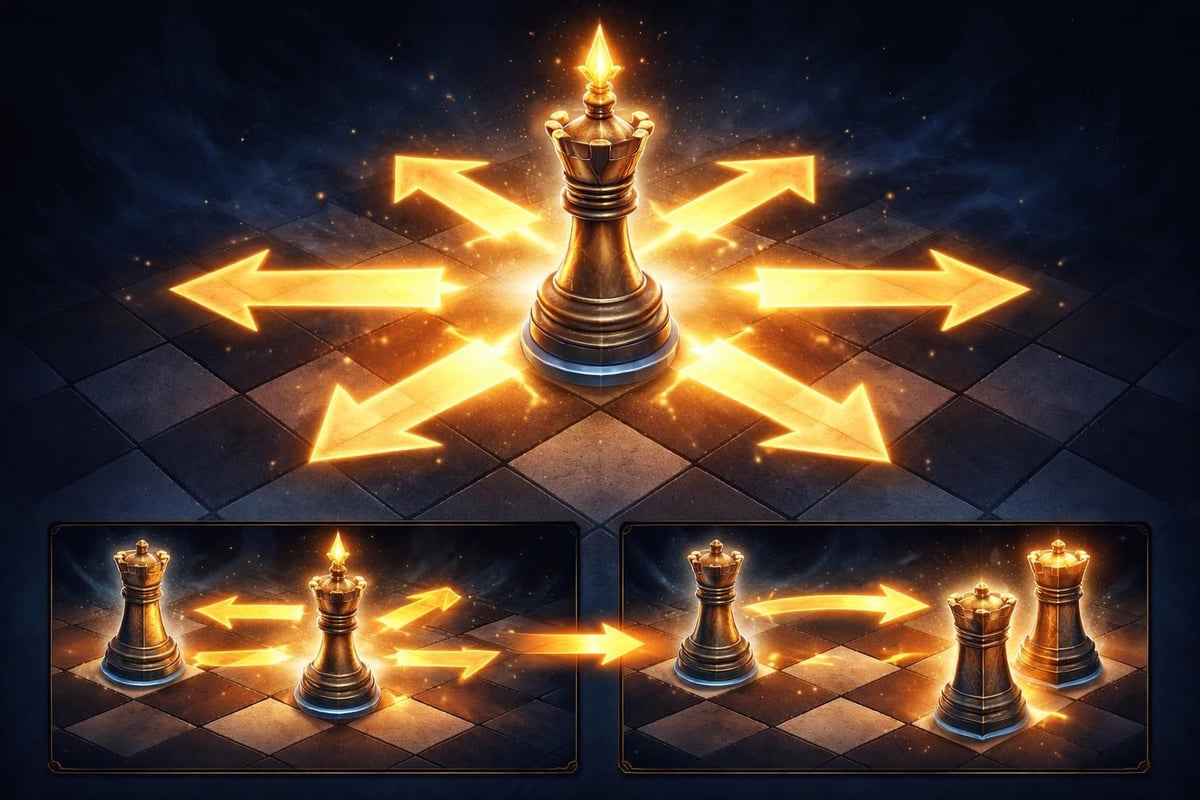
The special move called castling involves the rook and king working together, and it's one of the most important concepts in any explanation of chess pieces. According to the official rules of chess, castling allows you to tuck your king safely away while simultaneously activating a rook.
The queen combines the movement of both the rook and the bishop, making it the most powerful piece on the board. She can move any number of squares horizontally, vertically, or diagonally, giving her unmatched flexibility and attacking potential.
Valued at nine points, the queen is worth nearly as much as two rooks. Losing your queen early in the game without adequate compensation often leads to defeat, which is why protecting the queen while simultaneously using her attacking power is such a delicate balance.
| Queen Strengths | Strategic Considerations |
|---|---|
| Controls up to 27 squares from centre | Can become overworked if she's your only active piece |
| Combines rook and bishop powers | Vulnerable to attacks from lesser pieces |
| Excellent for creating multiple threats | Developing the queen too early invites attacks |
| Dominates open positions | Should typically be developed after minor pieces |
The queen excels in the middlegame where her mobility can create tactical fireworks. However, she's also crucial in many endgames, particularly when trying to deliver checkmate with minimal material. When you're exploring our luxury chess sets, you'll notice the queen is often the tallest piece after the king, befitting her status as the most powerful piece.
Every explanation of chess pieces must emphasize that the king is the most important piece, even though he's one of the weakest in terms of movement. The king can move one square in any direction: horizontally, vertically, or diagonally.
The entire objective of chess revolves around the king. You win by checkmating your opponent's king, and you lose if your own king is checkmated. This makes the king both precious and vulnerable throughout most of the game.
During the opening and middlegame, king safety is paramount. This is why castling exists as the only move involving two pieces, allowing you to move the king two squares toward a rook while the rook jumps over to the other side. It's a crucial defensive manoeuvre that every player should execute in nearly every game.
However, the king transforms in the endgame. When most pieces have been traded off, the king becomes an active, fighting piece. An active king in the endgame can support pawn advances, attack enemy pawns, and help deliver checkmate. This dual nature, requiring protection early but activation late, makes the king one of chess's most interesting strategic elements.
Understanding individual pieces is just the beginning. Real chess mastery comes from recognizing how pieces work together and knowing when their relative values change based on the position.
The traditional point system provides a helpful guideline:
But these values are fluid. A knight on a strong central square might be worth more than a bishop trapped on the back rank. Two bishops together often outweigh a bishop and knight. Rooks typically increase in value as the game progresses and files open up.
When you're examining the pieces in our wooden chess sets, you'll appreciate how the size and weight of each piece often reflects these relative values, with pawns being smallest and queens being tallest.
A complete explanation of chess pieces includes understanding that raw material count isn't everything. Three minor pieces (bishops and knights) can sometimes outweigh a queen. A rook and two pawns might be superior to two minor pieces, depending on the position.
This is where chess becomes art rather than arithmetic. Positional factors like piece activity, king safety, pawn structure, and control of key squares can outweigh material disadvantages. Grand masters regularly sacrifice material for overwhelming positional advantages or devastating attacks.
Understanding these nuances helps you appreciate why handcrafted Staunton pieces have remained the standard for serious play since the 1850s. The weighted, balanced design of quality pieces helps players physically interact with these strategic concepts, making piece coordination and material calculation more intuitive.
Beyond basic movement, several special rules govern how chess pieces interact. We've mentioned castling and en passant, but there's more depth to explore.
Castling requirements include:
Promotion strategy goes beyond automatically choosing a queen. Sometimes promoting to a knight (called underpromotion) delivers checkmate or avoids stalemate. Promoting to a rook or bishop is rare but occasionally useful in composed problems.
These nuanced rules separate casual players from serious students of the game. Understanding how each chess piece can be used creatively within the rules opens up endless tactical and strategic possibilities.
Knowing how pieces move is different from knowing how to develop them effectively. Here are fundamental development principles for each piece type:
| Piece Type | Development Priority | Common Mistakes |
|---|---|---|
| Pawns | Open lines for pieces, control centre | Moving too many pawns, creating weaknesses |
| Knights | Develop toward centre early | Placing on the rim in opening |
| Bishops | Develop to active diagonals | Blocking with your own pawns |
| Rooks | Connect through castling | Moving before minor pieces developed |
| Queen | Develop after minor pieces | Developing too early, becoming a target |
| King | Castle early for safety | Delaying castling, exposing king to attack |
These principles form the foundation of sound chess game openings and help you understand why experienced players make certain moves. Every piece needs a purpose, and developing them harmoniously creates a cohesive army ready for middlegame battles.
While functionality matters most in competitive play, the visual beauty and craftsmanship of chess pieces adds immeasurably to the playing experience. Traditional Staunton pieces feature distinctive designs that make each piece instantly recognizable: the cross-topped king, the crowned queen, the castle-like rook, the horse-headed knight, the mitre-topped bishop, and the simple pawn.
Quality sets often use contrasting woods like ebony and boxwood, creating striking visual appeal alongside practical playability. The weight, balance, and feel of well-crafted pieces enhance the tactile pleasure of moving them across the board. When you're investing in chess board pieces, you're not just buying game equipment; you're acquiring functional art that celebrates centuries of tradition.
This connection between form and function explains why chess has remained visually consistent across cultures while other games have changed dramatically. The pieces themselves tell a story of medieval warfare reinterpreted through strategic abstraction.
Reading an explanation of chess pieces provides the foundation, but true understanding comes through practice. Each piece has tactical patterns and strategic themes that emerge through play. Knights discover forks, bishops find pins, rooks dominate open files, and queens coordinate devastating attacks.
Start by playing slower games where you can think through each piece's role in your position. Consider which pieces are well-placed and which are passive. Ask yourself how each piece might improve its position or coordinate better with others. This analytical approach transforms theoretical knowledge into practical skill.
Whether you're playing casually at home or studying classical chess seriously, every game deepens your understanding of how these six piece types create infinite complexity. That's the magic of chess: simple rules producing limitless depth.
Understanding how each piece moves and functions is your first step toward chess mastery, but it's the quality of your chess set that turns learning into lasting enjoyment. When you're ready to invest in beautifully crafted pieces that bring this ancient game to life, Sterling Chess offers hand-selected sets combining heritage craftsmanship with modern playability. Our friendly team is here to help you find the perfect set for your journey, whether you're teaching the next generation or adding to a treasured collection.
Leave a comment