
Save $38.00
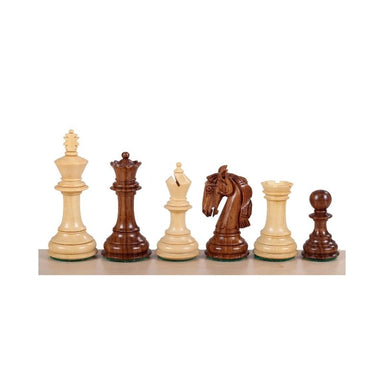
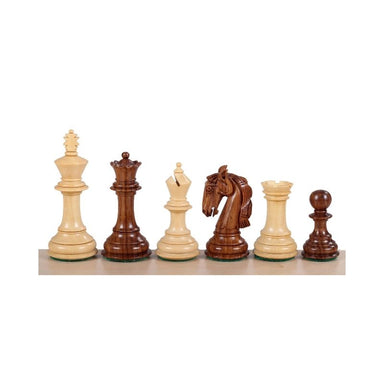
Dal Rossi French Lardy Boxwood & Sheesham Double Weighted Chess Pieces These are pieces for players who care how a set feels in the hand. T...
View full detailsThe classic design that every chess player recognises, Staunton chess pieces are the global standard for the game.
Introduced in 1849, the Staunton pattern became the official choice for tournaments thanks to its clean shapes, balanced proportions, and easy piece identification.
Whether you’re a new player learning the basics or an experienced competitor preparing for serious play, Staunton pieces deliver clarity, reliability and timeless style.
At Sterling Chess, we stock one of Australia's most refined selections of Staunton chess pieces, sourced from respected makers known for their craftsmanship and attention to detail.
Save $38.00
Dal Rossi French Lardy Boxwood & Sheesham Double Weighted Chess Pieces These are pieces for players who care how a set feels in the hand. T...
View full details
Sale
Dal Rossi French Lardy Boxwood & Rosewood Double Weighted Chess Pieces These are pieces for players who care how a set feels in the hand. T...
View full details
Save $44.00
Dal Rossi French Lardy Boxwood & Sheesham 150mm Double Weighted Chess Pieces These are pieces that make a statement. The Dal Rossi French L...
View full details
Sold out
Dal Rossi 95mm Chess Pieces With Storage Box The Dal Rossi 95mm Chess Pieces With Storage Box is a practical, entry-level Staunton chess piece ...
View full details
Save $-399.00
Play like a world-champion with the Sunrise Colombian Staunton Acacia/Boxwood chess pieces This set is built for players w...
View full details
Save $-519.00
Chamfered Base Staunton 104mm Chess Pieces The Chamfered Base Staunton takes its name from the detail it puts on every piece. Each base is cham...
View full details
Save $-339.00
Executive Staunton 108mm Chess Pieces The Executive Staunton is a plain, well made playing set. The shapes are classic Staunton proportions, ea...
View full details
Save $-379.00
French Grandmaster's Staunton 104mm Chess Pieces The French Grandmaster's is a club set first and everything else second. It is modelled after ...
View full details
Save $-319.00
New Classic Staunton 103mm Chess Pieces The brief for this one was improvement rather than invention. It is the latest Staunton in the line, an...
View full details
Save $-339.00
Alban Knight Staunton 102mm Chess Pieces The Alban Series is built on simplicity. It has been expertly carved out for stability, and there is n...
View full details
Save $-429.00
Fierce Knight Staunton 102mm Chess Pieces The Fierce Knight is named for its horse, and the name is not decoration. These knights are angry at ...
View full details
Sale
Majestic Series Staunton 101mm Chess Pieces The Majestic is an interesting take on the traditional Staunton pattern. It is elegantly designed a...
View full details
Save $-439.00
Professional Staunton Hand Carved 101mm Chess Pieces The first thing you notice is the shine. Every piece here carries a rich lacquer polish, a...
View full details
Save $-379.00
Parker Staunton Carved 100mm Chess Pieces The Parker's trick is the finish. Both armies are boxwood, one clearly darker in tone than the other,...
View full details
Save $-439.00
Royal Knight Staunton 99mm Chess Pieces The knight is the whole reason this set carries its name. A collector can follow the grain from the cre...
View full details
Save $-429.00
Exclusive Alban Staunton 99mm Chess Pieces The Alban is a Staunton with everything unnecessary taken out of it. The shapes are simple, they are...
View full details
Save $-309.00
Improved French Lardy 98mm Chess Pieces These chessmen reproduce the tournament sets Lardy made in France, and the listing comes two ways. What...
View full details
Save $-439.00
New Columbian Staunton 98mm Chess Pieces The New Columbian starts with the horse. Its posture and the symmetry running from the king to the paw...
View full details
Save $-519.00
2016 Sinquefield Cup Staunton 98mm Chess Pieces These chessmen are a reproduction of the chess pieces used for the 2016 Sinquefield Cup. The li...
View full details
Save $-379.00
Professional Staunton 98mm Chess Pieces This is a traditional Staunton followed to the letter. The proportions are FIDE's recommended ones for ...
View full details
Sale
Craftsman Staunton 98mm Chess Pieces The Craftsman chessmen are dedicated to the master artisans who designed them, and the knight is where tha...
View full details
Save $-529.00
Rare Columbian 117mm Chess Pieces The Rare Columbian is a large Staunton, triple weighted, standing 117mm at the king and made for boards cut b...
View full details
Save $-369.00
Unique Old Columbian 99mm Chess Pieces The Old Columbian is a weighted Staunton in golden rosewood and boxwood, 99mm to the king, and cut for 5...
View full details
Save $-399.00
Artisan Carving Burnt Zagreb 95mm Chess Pieces Both armies on this set carry a burnt finish, and they do not carry it equally. That difference ...
View full detailsThe Staunton pattern is the design almost every chess player pictures when they think of a chess piece. Sterling Chess carries it across the full range of the game: club and tournament armies, reproductions of famous historical patterns, heavily weighted luxury sets in ebony and bud rosewood, and compact sizes for small boards. Kings in this collection run from 60mm up to just under 160mm. These are piece sets on their own. If you would rather buy the pieces and the board together, the Staunton chess sets range pairs them for you.
The pattern was registered at the UK Patent Office on 1 March 1849 by John Jaques of London, working from a drawing by Nathaniel Cooke. Howard Staunton, the strongest English player of the day, endorsed it and his signature appeared on the boxes, which is how his name stuck to a design he did not draw.
What the design solved was recognition. Before 1849, English sets varied from workshop to workshop and pieces could be hard to tell apart across a board. The Staunton answer gave every piece a distinct silhouette: a crown surmounted by a cross on the king, a coronet on the queen, a mitre with a diagonal slot on the bishop, a carved horse's head on the knight, a castellated tower on the rook, and a plain ball-topped pawn. You can read a Staunton position from the far side of a room, and that is the whole point of it.
FIDE's equipment standard says pieces used in competition should be of the Staunton style, in wood, plastic or materials imitating them. It is a style requirement rather than a single approved product, which is why so many different makers and patterns sit inside it. If you want the piece-by-piece detail, our guide to chess piece names and meanings covers what each shape represents.
King height is the first decision, because everything else on the board follows from it. The other five pieces are turned in proportion, and the board you play on has to suit the footprint of the army.
The FIDE standard puts the king at 95mm, with the queen at 85mm, bishop 70mm, knight 60mm, rook 55mm and pawn 50mm. Up to 10 per cent variation is allowed provided the pieces keep that order of height, so a king anywhere from roughly 85mm to 105mm is within the standard. This is the busiest part of the range and where most club players land. The tournament chess pieces selection narrows it further to sets built specifically for competition play.
Above about 105mm the pieces stop being tournament equipment and start being furniture, in the best sense. A 110mm to 120mm king wants a generous board and a table with room around it, and the extra height gives carvers somewhere to put detail that would be lost on a club set. The heavier and more elaborately carved sets sit in luxury chess pieces. For anything larger again, the giant chess range covers garden and floor sizes.
Below 85mm the Staunton shapes still read clearly, but the set becomes something you can keep out on a side table or pack for travel. Kings from 60mm to 80mm suit smaller boards, shared desks and children learning the game. The proportions are the same; there is simply less of everything.
Weighting is lead or a similar dense material set into the base under the felt. It is not decoration. A weighted piece stays where it is put, resists a knocked elbow, and gives a satisfying settle when it lands on a square.
Base felt matters as much as the weight. A good pad lets the piece slide rather than scrape, protects a lacquered board, and keeps the set quiet. Every wooden set in this collection is felted.
Boxwood is the traditional light timber and still the most common. It is dense, close-grained and takes fine carving without chipping, which is why the knight on a good boxwood set holds its detail. Some sets use antiqued or distressed boxwood, where the surface is deliberately aged to a warmer, softer tone rather than left bright.
Ebonised boxwood is boxwood stained black. It gives a matched pair, since both armies are then turned from the same timber and behave the same way over time. Genuine ebony is the heavier and more expensive alternative, with a deep natural black and real weight of its own before any ballast is added. Sheesham, rosewood and bud rosewood sit between the two, running from warm reddish brown to a dense figured chocolate. The full timber range is in wood chess pieces.
A large part of this collection is made up of reproductions of specific patterns from chess history: the original 1849 Jaques design, the Zagreb 1959 pattern, French Lardy club sets, and the sets used at named tournaments through the twentieth century. They are turned to the original proportions rather than to modern club shapes, so they read differently on the board. Browse them all in reproduction chess pieces.
The square has to suit the king's base, not the king's height. A crowded board makes a position hard to read and hard to play; too much space around each piece looks thin. The practical test is that the square should be comfortably wider than the king's base, with enough room left for two pieces to stand on adjacent squares without touching. FIDE puts competition squares between 5cm and 6cm, and sets the base diameter of each piece at 40 to 50 per cent of that piece's own height. Board options are in chess boards, with timber options in wood chess boards and competition sizes in tournament chess boards.
Pieces also need somewhere to live between games. Fitted cases and trays are in chess piece storage boxes.
Most people arrive at a pieces-only collection for one of three reasons. They already own a board they like and want an army that suits it. They have a set with a damaged or missing piece and want a replacement army rather than a repair. Or they want to build a setup deliberately, choosing the timber and the weight themselves instead of accepting whatever a boxed set pairs together.
All three are well served here. If you would rather not make the decision twice, tournament chess sets and the wider chess pieces range give you matched options and the full catalogue respectively.
Staunton is not the only pattern worth owning. If you are after something different:
Every set here is held in Australian stock and shipped from Australia, so there is no international freight wait and no customs surprise. Orders are packed with the pieces individually wrapped, because a loose army in transit is how knights lose ears.
All products sold by Sterling Chess are backed by a 12 month limited manufacturer warranty. This covers manufacturing defects and cracking, and ensures every product is 100% genuine. Sterling Chess also offers 100 day free returns, so a set that turns out to be the wrong size for your board can be sent back.
The six piece shapes registered in London in 1849: a cross-topped king, a coronet queen, a slotted mitre bishop, a carved horse's head knight, a castellated rook and a ball-topped pawn, all turned in proportion to each other. A set that follows those shapes is a Staunton set, whoever made it.
For club and tournament play, a king between 85mm and 105mm suits the standard. Above that you are buying for presence rather than competition, and below it for compactness. Check the board first: the square needs to be comfortably wider than the king's base.
FIDE's equipment standard says pieces used in competition should be of the Staunton style, in wood, plastic or materials imitating them. It describes a style rather than approving one product, so a wide range of Staunton sets qualifies.
It refers to how much ballast is set into the base beneath the felt. Double weighted is the usual club standard. Triple weighted is heavier again and suits larger sets and players who prefer a firmly planted piece.
Boxwood for the light side is the traditional choice and holds carving detail well. For the dark side, ebonised boxwood gives a matched pair at a lower price, genuine ebony gives natural weight and depth, and sheesham or rosewood give warmth and visible grain.
Yes. These are piece sets, so you can pair them with a board of your choosing. The Staunton chess sets range pairs pieces and a board together if you would rather buy both at once.
You can buy a complete replacement army here, which is what most people want when a piece is lost or damaged. Matching a single piece to an existing set is rarely possible, since timber, finish and turning vary between makers and production runs.
Thirty-two as standard. Many sets include one or two spare queens for promotions, which takes them to thirty-three or thirty-four. The count is listed on each product page.
On the higher-end sets, yes. The knight is the piece that separates a good set from an ordinary one, because it is the only one that cannot be produced on a lathe alone. Carving quality is described on each product page.